Teaching children about money: rands and cents made easy
Fun, age-by-age ways to teach South African children about rands and cents, from recognising coins to giving change, saving and running a pretend spaza shop.
 By the Asifunde Nathi team · 5 min read
Money is one of the most practical things your child will ever learn, and one of the easiest to teach at home, because it is all around us: at the spaza shop, the supermarket till, the taxi rank and the tuck shop. Children who understand money early count better, make smarter choices and grow into confident adults.
Here is a step-by-step guide to teaching South African children about rands and cents, with games and activities for every age.
In this article
Meet South African money
Before your child can count money, they need to recognise it. South African money is the rand (R), and 100 cents (c) make one rand.
Coins
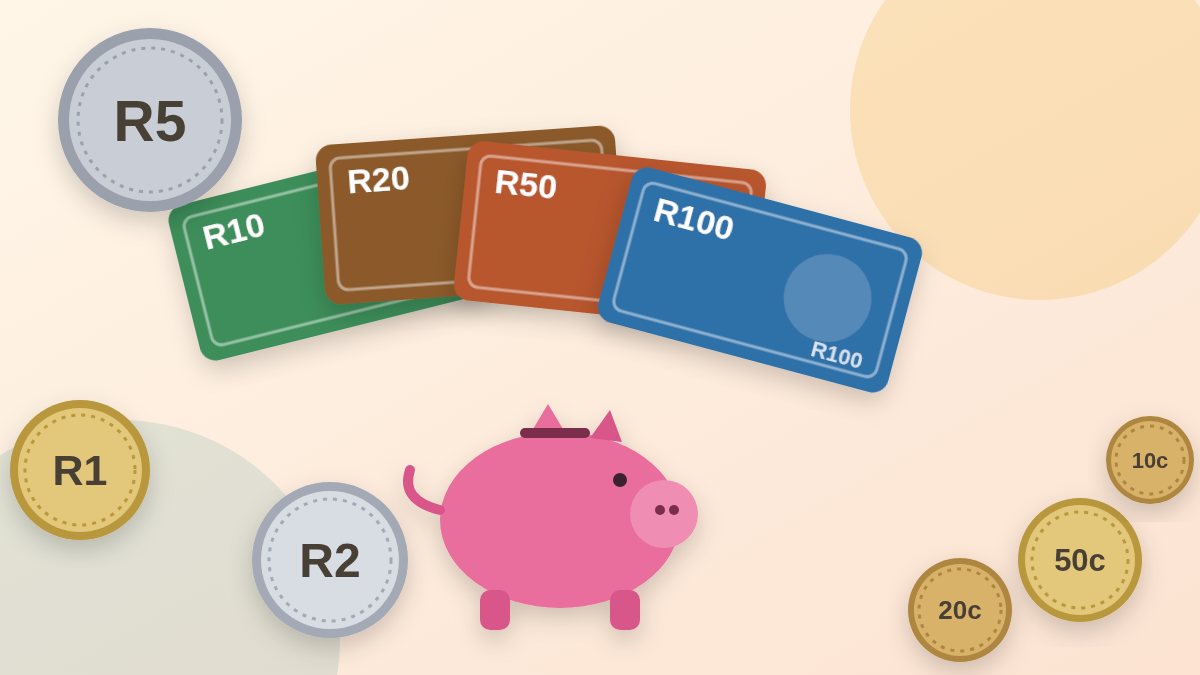
The coins your child will see most often are 10c, 20c, 50c, R1, R2 and R5.
Banknotes
The banknotes are R10, R20, R50, R100 and R200. Here is a fun fact children love: each note shows one of the Big Five animals.
| Note | Animal |
|---|---|
| R10 | rhino |
| R20 | elephant |
| R50 | lion |
| R100 | buffalo |
| R200 | leopard |
Lay out the notes and ask your child to find the elephant or the lion. It is a great first money game.
Ages 3 to 5: recognising and sorting
At this age, children are learning what money looks like and that it is used to buy things.
- Sort the coins. Mix up coins and sort them by size, colour or value into egg-box cups.
- Spot the animal. Use banknotes (or printed pictures of them) to play "find the rhino".
- Count the same coins. "How many R1 coins are there? One, two, three... three rand!"
- Play shop. Set up a pretend shop with tins and fruit from the kitchen and let your child "pay" with coins.
- Name it in the home language. Count coins in isiZulu, Sesotho or your home language as well as English. Counting in two languages strengthens both.
Always supervise young children with real coins, as they are a choking hazard.
Ages 5 to 7: counting and adding
Now children can start adding values together.
- Add two coins. "R2 and R1 make how much?"
- Count in twos and fives. Use R2 and R5 coins to practise skip counting.
- Make R10. Give your child a pile of coins and ask them to make R10 in different ways.
- Price tags. Put simple price tags (R3, R5, R8) on items in your pretend shop.
- Real shopping. Let your child pay for a small item at the shop and count the change with you.
Ages 7 to 10: change, cents and decisions
Older children can handle cents, change and choices.
- Give change. "The bread costs R18 and you pay with R20. How much change?"
- Rands and cents. Practise amounts like R12.50: "That's twelve rand and fifty cents."
- Compare prices. Which is better value: one big packet or two small ones?
- Budget for a treat. Give a set amount (say R50) for a family outing snack and let your child plan what to buy.
- Needs and wants. Talk about the difference between things we need (food, school shoes) and things we want (sweets, toys).
Start saving
Saving teaches patience and planning, two skills that last a lifetime.
- Use three jars: spend, save and share. When your child receives money, help them divide it between the jars.
- Set a goal. A soccer ball or a book. Draw a chart and colour it in as savings grow.
- Talk about waiting. Explain that saving means waiting now to get something better later.
Pocket money: yes or no?
Many families give pocket money from about age 6 or 7. There is no right amount, but a few tips help:
- Give it on the same day every week.
- Let your child make small mistakes. Spending it all on sweets and having nothing left is a valuable lesson.
- Talk about choices without lecturing.
- Encourage some saving every week.
Everyday money moments
You do not need special lessons. Money is everywhere in daily life:
- At the supermarket, ask your child to find the cheaper option.
- In a taxi, let them work out the fare for the family.
- At the till, ask them to check the change.
- When paying bills, talk simply about what electricity or data costs.
Learn money through play
Children learn money skills fastest through play. In Asifunde Nathi, children count coins and banknotes in rand and cents, and the Spaza Shop game lets them run their own shop and count the rands. Activities adjust to your child's age and are available in nine South African languages. Try it free for 7 days.
For more ideas, see screen-free learning games every South African child should know and homeschooling in South Africa.
Questions parents ask
What age should children start learning about money?
From about age 3, children can start recognising coins and playing shop. Counting and adding money usually comes between 5 and 7, and giving change and budgeting from about 7 onwards.
Should I use real money or toy money?
Both work. Real coins help children recognise actual money, but always supervise young children because coins are a choking hazard. Printed or toy money is great for pretend shops.
How do I explain card and phone payments to my child?
Explain that cards and phones use money stored in a bank account. Even though we cannot see it, the money is still being spent. Showing your child a simple budget helps make "invisible" money real.
Is it okay to pay children for chores?
Families choose differently. Some pay for extra jobs beyond normal household chores, which teaches that work earns money. Others prefer to keep chores as part of family life. Either way, be consistent.