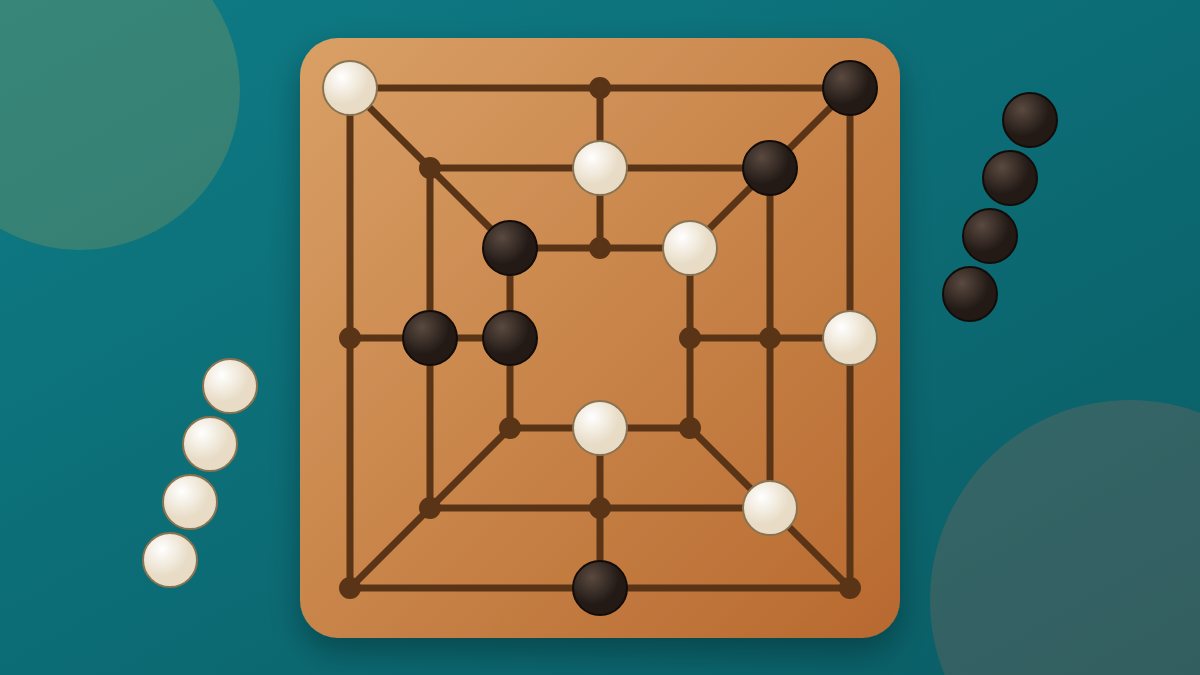
Morabaraba rules for kids: how to play, step by step
A simple guide to morabaraba, South Africa's favourite strategy board game. Draw the board, learn the rules for placing, moving, flying and making mills, and teach it to children by age.
 By the Asifunde Nathi team · 7 min read
Morabaraba is a two-player strategy game that has been played across Southern Africa for generations. Herd boys scratched the board into the sand while they looked after the cattle, which is why the pieces are still called cows. In isiZulu and isiXhosa the game is known as umlabalaba, and today it is a recognised mind sport in South Africa, with school leagues and national colours.
The best part for parents: it costs nothing, it takes five minutes to learn, and it quietly teaches children to plan ahead. This guide gives you the rules in plain language, shows you how to draw a board at home, and suggests how to teach it at every age.
In this article
What you need
- A board. Draw it on paper or cardboard, chalk it onto the stoep, or scratch it into the sand.
- 24 cows. Each player needs 12 pieces in their own colour. Bottle tops, buttons, beans, stones or coins all work.
- Two players. Morabaraba is a game for two, but a third child can be the "referee" and count the cows.
How to draw a morabaraba board
- Draw a big square.
- Draw a medium square inside it, and a small square inside that, so you have three squares, one inside the other.
- Draw a line from the middle of each side of the big square, through the middle of the medium square, to the middle of the small square. That's four short lines.
- Draw a line from each corner of the big square, through the corner of the medium square, to the corner of the small square. These four diagonal lines are what make morabaraba different from similar games played overseas.
You now have 24 points: the four corners and four middles of each square. Cows always stand on these points, never in the spaces between them.
The rules, step by step
1. Placing your cows
Players take turns to place one cow at a time on any empty point. Keep going until both players have placed all 12 cows. You are already playing the game during this stage, so think about where you put each cow.
2. Make a mill and shoot a cow
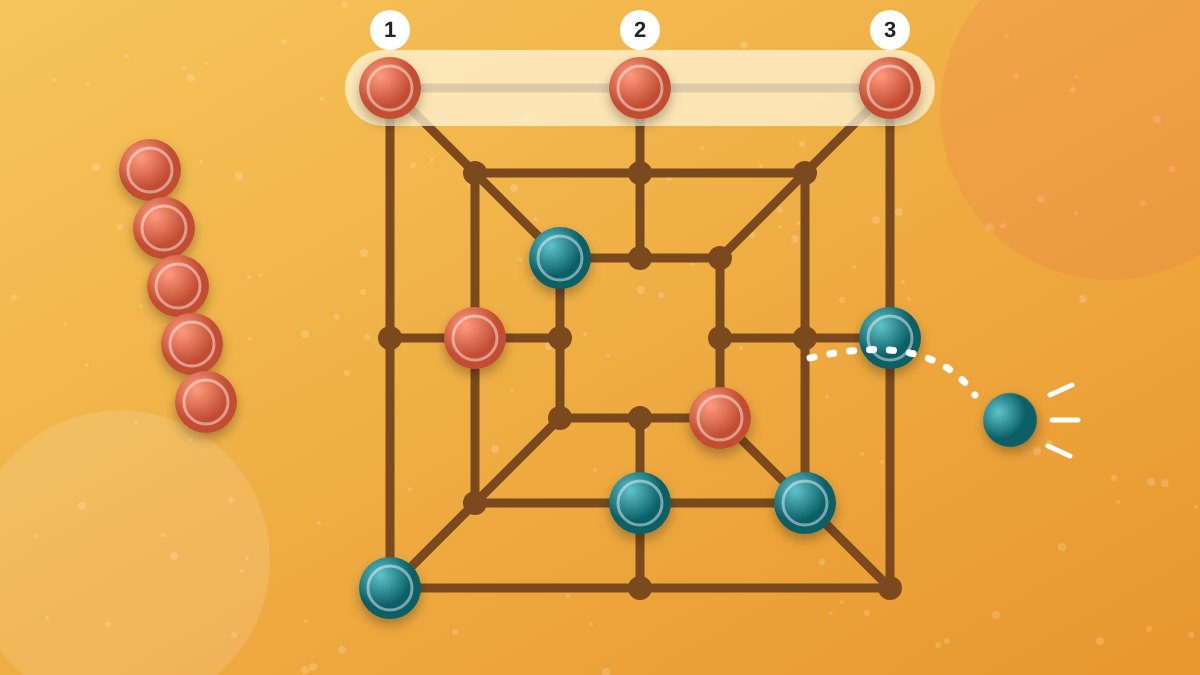
A mill is three of your cows in a straight row along one of the lines on the board. That can be along the side of a square, along one of the short middle lines, or along a diagonal.
When you make a mill, you may shoot (take off) one of your opponent's cows. The cow you shoot leaves the game.
- You can't shoot a cow that is part of a mill, unless every one of your opponent's cows is in a mill.
- Even if one move makes two mills at the same time, you shoot only one cow.
3. Moving your cows
Once all the cows are on the board, players take turns to move one cow along a line to an empty point next to it. You can't jump over other cows. Keep trying to make new mills, and to stop your opponent from making theirs.
You may open one of your own mills by moving a cow out, and then close it again later to shoot again. Many clubs and the official tournament rules don't allow you to close the same mill again on your very next move, so it's a good rule to use at home too.
4. Flying
When a player is down to only three cows, their cows can fly: on their turn, they may move a cow to any empty point on the board, not just a neighbouring one. This gives the player who is losing a fighting chance.
5. How to win
You win when your opponent:
- has only two cows left, so they can never make a mill again, or
- can't make a move because all their cows are blocked.
Many families also agree on a draw rule: if a player has only three cows and nobody shoots a cow within ten moves, the game is a draw.
Rules vary a little between regions and families. Agree on yours before you start, and let grandparents teach you the version they grew up with.
Teaching morabaraba by age
| Age | Try this | What they practise |
|---|---|---|
| 4 to 5 | Use only the small square and three cows each. Take turns to place them and try to make a line of three. | Taking turns, spotting lines, counting to three |
| 6 to 7 | Full board, placing and mills only. Stop when all cows are placed and count who has more. | Planning one move ahead, blocking |
| 8 to 9 | Full rules with moving. Leave out flying until they're confident. | Thinking two moves ahead, patience |
| 10 and up | Full rules with flying and the draw rule. Try timing moves for an extra challenge. | Strategy, staying calm under pressure |
Strategy tips for young players
- Not all points are equal. Every point on the medium square connects to four neighbours, while points on the big and small squares connect to only three. The medium square is a strong place to stand.
- Block first, attack second. If your opponent has two cows in a row with an empty point next to them, cover that point before you do anything else.
- Build "open" mills. Two cows in a row with an empty space on each side are hard to block.
- Keep cows free to move. In the moving stage, a cow that is boxed in is a cow you can't use.
- Count the cows out loud. It's good maths practice, and children love announcing the score.
What children learn from morabaraba
Morabaraba builds the same thinking skills as chess, with a game children can learn in minutes. It teaches planning, patience, counting, spatial thinking and good sportsmanship. It is also a lovely way to talk about why cattle matter so much in many Southern African cultures, and to connect children with games their parents and grandparents played.
To bring in the home language, count the cows, name the colours and say "your turn" and "my turn" in your family's language while you play.
Play it on paper, on the app, or in a colouring book
When there's no board handy, Asifunde Nathi has a digital version of morabaraba, alongside counting games and stories in nine South African languages.
Our Sepedi colouring book, Games We Play, has a morabaraba page, plus diketo, skipping, hopscotch, wire cars and more, each with Sepedi words to learn.
For more traditional games to play together, read 8 screen-free learning games every South African child should know.
Questions parents ask
What age can children start playing morabaraba?
Most children can learn the placing-and-mill part of the game from about age 6. Four- and five-year-olds enjoy a mini version on the small square with three cows each, which works like noughts and crosses.
How long does a game of morabaraba take?
A game between children usually takes 10 to 20 minutes. Experienced players can play much faster.
Is morabaraba the same as nine men's morris?
They are related "mill" games. Morabaraba uses 12 cows each and a board with diagonal lines, while nine men's morris, played in Europe, uses nine pieces each and has no diagonals.
Can my child play morabaraba competitively?
Yes. Morabaraba is a recognised mind sport in South Africa, and Mind Sports South Africa organises school, provincial and national competitions. Ask your child's school if they have a mind sports club.
My child keeps losing. How do I keep it fun?
Play the mini version, let them place first, or play "open hand" where you explain why you're making each move. Celebrate good moves, not just wins.